

What is Acai (Açaí)?


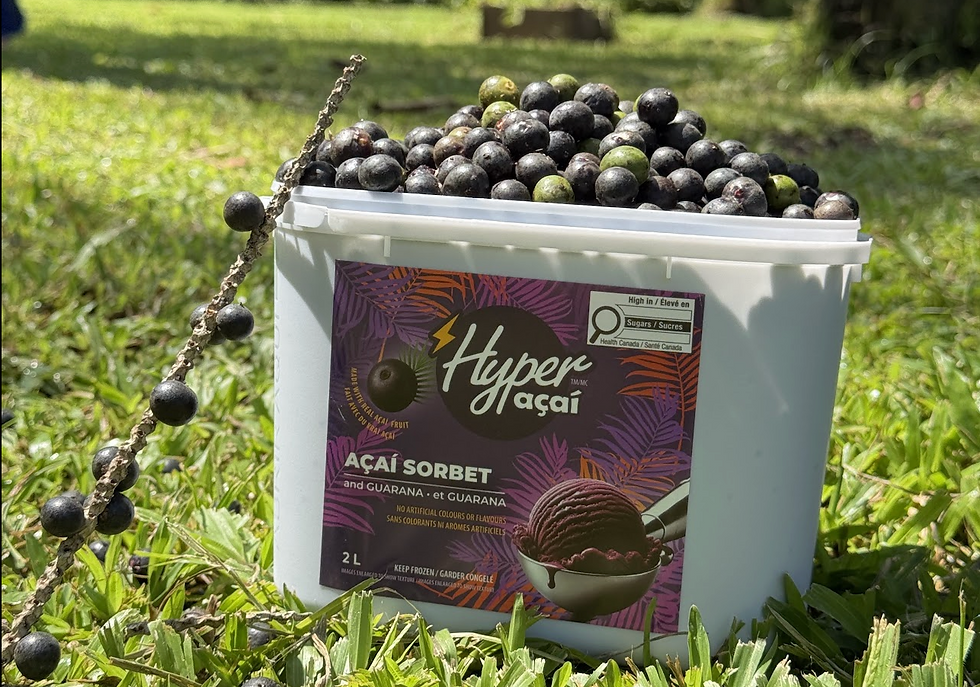
Acai (Açaí) is a small, dark purple fruit that grows on the açaí palm tree native to the Amazon rainforest. Technically, it’s a drupe—a type of fruit with a large seed (or pit) inside, like a cherry or olive. Only about 10–15% of the fruit is edible pulp, the part that ends up in your smoothie bowl or sorbet.
Most people have never seen an açaí fruit on the tree. Watch Hyper Açaí co-owner Fernando introduce the fruit straight from the Amazon:
Why Is Acai (Açaí) So Special?
The short answer? Antioxidants—specifically, anthocyanins.
Anthocyanins are the compounds that give berries their vibrant blue and purple hues. They’re powerful antioxidants that help protect our bodies from oxidative stress and free radical damage. If blueberries are famous for their antioxidant content, açaí takes it up several notches.
Let’s compare the numbers:
100g of blueberries has an ORAC (Oxygen Radical Absorbance Capacity) score of 4,669
100g of açaí? A whopping 15,405
That’s more than triple the antioxidant power of blueberries and nearly 30 times more than red wine. This high ORAC score means that açaí can help support cellular health, reduce inflammation, and protect against oxidative stress, which is linked to aging and chronic disease.
Açaí’s Nutritional Benefits at a Glance:
High Antioxidant Power: Helps fight oxidative stress and inflammation
Rich in Healthy Fats: Contains omega fatty acids, especially oleic acid
Low in Sugar: Naturally low in sugar compared to other fruits
Supports Heart Health: Thanks to those healthy fats and antioxidants
Promotes Skin and Brain Health: Due to its nutrient-dense profile
What Does Acai (Açaí) Taste Like?
Beyond its nutritional punch, açaí also has a unique flavor. It’s not your typical sweet berry. Instead, it has a smooth, earthy, slightly tart taste with rich notes often compared to dark chocolate or red wine. That “buttery” smoothness comes from its healthy fat content—açaí contains omega-3, 6, and 9 fatty acids, particularly oleic acid, a heart-healthy monounsaturated fat also found in olive oil. See below the Nutrition Facts for 100% pure organic açaí pulp per 100 g pouch showing 64 calories, 4 g fat, 6 g carbohydrates, 2 g fibre, 0 g sugar, 1 g protein, and one ingredient: organic açaí pulp.

Where Does Acai (Açaí) Come From?

Açaí comes from the heart of the Amazon rainforest, where it has been a dietary staple for centuries—especially in northern Brazil, in states like Pará and Amazonas. The açaí palm (Euterpe oleracea) grows abundantly along riverbanks and floodplains, thriving in the hot, humid climate of the Amazon basin. While it’s now known around the world, açaí has deep roots in Indigenous and local Amazonian culture, where it’s eaten daily and used for its powerful health properties.
Skilled local workers—often referred to as ribeirinhos, or river people—scale palm trees that can grow over 25 meters (80 feet) high to reach the clusters of açaí berries. This is typically done by hand, using traditional climbing techniques with nothing more than a rope looped around the feet for grip and balance.
These harvesting methods aren’t just impressive—they’re also deeply sustainable. Families and communities have passed down this knowledge through generations, managing the land with a focus on long-term preservation. Instead of mass deforestation or destructive harvesting, açaí collection is often done in a way that maintains the health of the forest and supports biodiversity.
Today, this sustainable supply chain provides jobs and income for thousands of Amazonian families, making açaí not only good for your health but also good for the planet and the people who live in the region. Many açaí producers also follow fair-trade and organic practices to ensure the fruit reaches your bowl with integrity and care.
With rising demand across the globe, açaí is now exported from Brazil to countries like the U.S., Canada, and those across Europe and Asia. However, authentic Brazilian açaí—especially the kind harvested with traditional methods and minimal processing—remains the gold standard for quality and nutritional value.


What draws my attention to helping students build consistent learning routines is the possibility of making an unfamiliar subject feel closer to everyday life. A regular starting point can reduce the effort needed to begin a demanding task. It gives me a more concrete starting point for thinking about consistent student routines. A short discussion of an everyday example would make this easier for me to connect with, especially as someone still learning about the subject. How can a routine stay useful as a student's workload changes?
When it comes to connecting classroom learning with Bratkowice, I would rather understand one useful detail properly than rush through a long list of ideas. A local topic can invite pupils to contribute knowledge that is not found in their textbook. This is why I would approach Bratkowice school projects with a specific question rather than a fixed expectation. I am still thinking through the details, and a small example would help me picture how this works in practice. How would you make room for those contributions while keeping the project focused?
Trước giờ tôi chỉ nghe tên acai trong vài câu chuyện về đồ ăn nên đọc bài này mới chú ý xem nó thực sự là gì. Cách một cái tên lạ khiến người ta tò mò làm tôi nhớ đến lần ngồi nghỉ, nghe người quen nói về game bài đổi thưởng rồi nhắc SC88; tôi chỉ biết tên chứ chưa dùng và cũng chưa rõ cụ thể ra sao. Quay lại với acai, điều tôi quan tâm nhất vẫn là nguồn gốc, cách sử dụng và liệu những lời truyền miệng quanh nó có bị nói quá hay không. Bài viết giúp tôi có thêm một khung thông tin để tự phân biệt.
Tôi chưa từng biết quả acai ngoài vài lần thấy tên trong các bài về đồ ăn lành mạnh, nên bài này giúp tôi hình dung rõ hơn về nguồn gốc và cách người ta thường nhắc đến nó. Đoạn nói về việc không nên xem một loại thực phẩm như giải pháp cho mọi vấn đề sức khỏe khá hợp lý. Tôi đọc bài lúc đang chờ bữa sáng, trong lúc đó có nhớ đến một cuộc trò chuyện cũ về game bài đổi thưởng, nơi cái tên SC88 được nhắc qua như một lựa chọn giải trí, nhưng tôi không có trải nghiệm gì với nó. Cảm giác chung sau bài là nên nhìn thông tin vừa đủ, không…
Thinking about connecting vocational learning with Golub-Dobrzyn, I find the smaller practical questions more interesting than a quick conclusion. A realistic practical task can help students see why a classroom concept matters. It makes me curious about the practical side of Golub Dobrzyn vocational education. I am still thinking through the details, and a small example would help me picture how this works in practice. How would you connect an assignment with the situations a learner might encounter at work?